US Utility Market Plays Catch-Up to Data Centre Load Growth
06 August 2026
Article written by Aisling Hubert Developers scramble for interconnection, leading to double counting of projects by utilities In 2025, Pacific Gas and Electric Company (PG&E) was forced to revise downwards […]
Article written by Aisling Hubert
Developers scramble for interconnection, leading to double counting of projects by utilities
In 2025, Pacific Gas and Electric Company (PG&E) was forced to revise downwards its forecast data centre pipeline by roughly 400 MW – equivalent to 25 data centres or 250,000 homes. This write-down was due to the double, triple and sometimes quadruple counting of data centres, as developers seek to hedge their bets due to lengthy and uncertain electricity interconnection queues. Similarly, AEP Ohio cut its list of pending projects by 30%, removing data centre developers with only speculative financial strength from its queue.
Interconnection challenges have emerged as one of the most significant risks to the pace of data‑centre expansion. Google’s Head of Sustainability and Climate Policy, Marsden Hanna, stated that “Transmission barriers are the number one challenge we’re seeing on the grid”, and, “We have utilities in many markets telling us four or five, sometimes ten years to interconnect”. Currently, it takes on average seven years for project interconnection in the US.
Challenges with interconnection have already stunted data centre rollout in other countries such as Ireland where the application accounts for roughly 22% of the country’s electricity consumption, more than all residential use in the country. This figure has risen by 531% since 2015. As a consequence, in 2021, Ireland instated a temporary moratorium on new data centre rollouts until new legislation was passed in December 2025. Now, any data centre seeking a grid connection must install on-site generation or battery systems capable of meeting its full electricity demand, with 80% coming from renewable energy. Operators will also be required to provide power back to the national grid when needed.
US ratepayers’ electricity bills are up by as much as 16% y/y in data centre heavy states
The current system of US ratepayers footing much of the bill for data centres has had ramifications on average electricity prices, which rose by 7% on average from October 2024 to October 2025 – even more in states with high data centre loads, such as Illinois, which rose by 16% y/y.
Electricity prices are already a politically sensitive issue in the US, with residential tariffs rising meaningfully since 2021. Against that backdrop, hyperscale data centres, which are often highly visible, water-intensive and tax-advantaged, have become focus areas for public concern. The core fear is that utilities will be forced to overbuild generation, substations and transmission to serve uncertain large loads, with the costs spread across all customers. Several utilities and regulators have explicitly acknowledged this risk, prompting new tariff structures that require large loads to underwrite upgrades or commit to minimum take-or-pay volumes, sometimes as high as 85% of contracted demand.
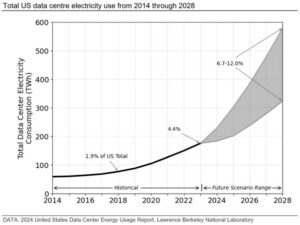
The US Department of Energy now forecasts 20 GW of incremental data-centre load by 2030 and estimates that data centres could account for 6.7% to 12% of total US electricity consumption by 2028, up from 4.4% in 2023. For a three-year horizon, that range is extraordinarily wide and highlights the scale of uncertainty utilities are being asked to plan against. The main question is who will take on the costs associated with planning for this uncertainty.
ERCOT introduces stricter interconnection criteria
With the scale of the challenge against the historically slow-moving grid institutions, changes are being implemented at a policy level to try and get power generation and interconnection planning up to speed. At the federal level, proposals have emerged to accelerate permitting and explore new procurement mechanisms that force large loads to “pay their way”. PJM, under direction from federal regulators, is developing new frameworks for connecting large loads that bring their own generation, accept curtailment risk or rely on flexible interconnection arrangements rather than firm capacity.
In Texas, ERCOT (Electric Reliability Council of Texas) serves 90% of the state. This independent system operator is responsible for managing the grid reliability, generation and power pricing. In early 2026, ERCOT announced “Batch Zero”, a new planning system for large load interconnection. With this, developers with loads over 75 MW will face stricter eligibility criteria and maturity requirements, ensuring projects are prioritised effectively and delays are reduced. It also will prioritise projects that bring their own generation – a move being seen across global energy markets.
Gas turbine demand has spiked as data centres try to circumnavigate the grid
Alongside regulatory reform, data-centre operators are increasingly turning to technical solutions that reduce reliance on traditional grid expansion. One approach is co-location with power generation, allowing data centres to connect “behind the meter” and limit their net withdrawals from the grid. Another is the expanded use of on-site generation, including gas turbines originally designed for aviation to bridge multi-year interconnection delays.
The demand for gas turbines has risen dramatically, and with average wait times of five years at present, demand has also fuelled a substantial secondary market. Going forward, nuclear small modular reactors could provide an optimal solution, though regulation renders it an unfeasible solution for now.
Aluminium overhead cable demand has risen by roughly 9% CAGR from 2020–2026
CRU has written previously on the demand for wire and cable within data centre campuses themselves. Here, we attempt to understand the changing demand to the wider electricity grid which, in the US, is mainly comprised of aluminium overhead conductors in the form of ACSS (Aluminium Conductor Steel Supported) and ACSR (Aluminium Conductor Steel Reinforced).
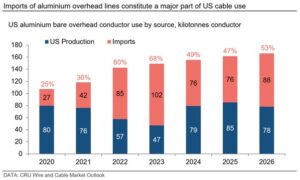
Historically, a large portion of the aluminium overhead conductors used in the United States have been imported. This percentage share of imports rose to a record high of 68% in 2023, when challenges with domestic US production prompted utilities to look overseas to fulfil their grid obligations. Since then, production has normalised – meanwhile, demand for aluminium overhead lines has risen by an average of 9% CAGR between 2020 and 2026 rising from 107 kt conductors used to 166 kt conductors, respectively. CRU understand that roughly half of cable procurement is used for ongoing maintenance and reconductoring, with the other half being used for new transmission and distribution projects.
Expansion of aluminium conductor production from existing players is likely as demand grows and tariffs take effect
The rapid expansion of data‑centre demand is reshaping not only utility planning but also the structure and urgency of investment across the US wire and cable supply chain. As interconnection delays lengthen and regulators tighten eligibility criteria, “bring your own power” solutions and greater on‑site generation will increasingly become the norm for hyperscalers driving demand for behind-the-meter power, including wind, solar and battery storage solution.
At the same time, Section 232 tariffs on steel and aluminium will benefit the investment attractiveness for US‑based aluminium overhead line production, which has been neglected in recent years due to lower margins commanded compared to high-voltage insulated cable products and EPC projects. CRU expects that this convergence of structural load growth, policy intervention and shifting procurement strategies will spur further cable manufacturing capacity additions and localisation efforts among US producers.