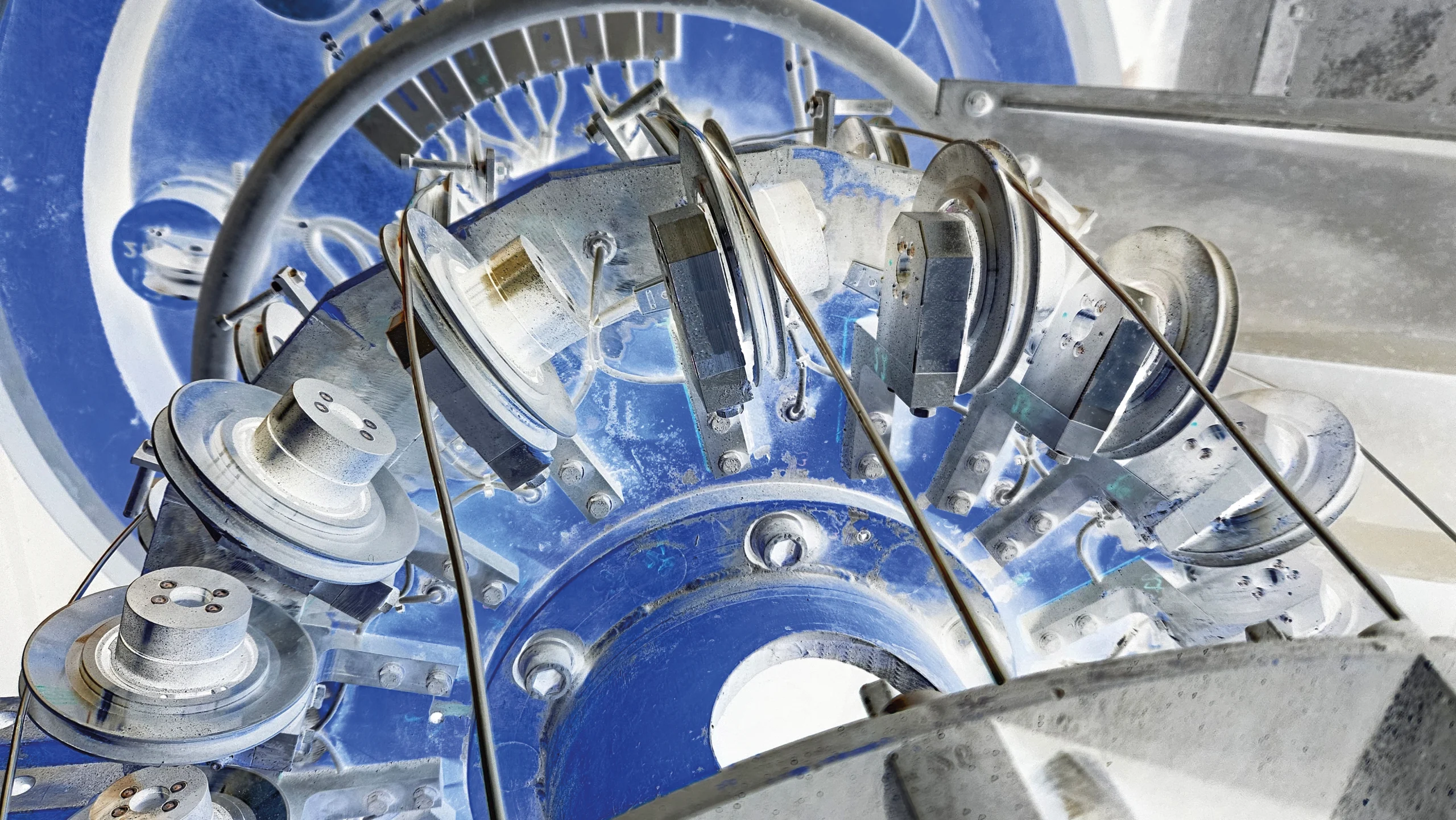
Stranding machines are among the most productivity-critical pieces of equipment in the wire and cable industry. For the first time, a wireless condition monitoring system enables the continuous monitoring of key process and condition parameters directly on the rotating machine components.
Greater Transparency in the Stranding Process
Downtime on stranding machines results in high costs. At the same time, many critical process parameters are difficult to access because they occur on rotating parts of the machine. In particular, wire tension, braking forces, temperature trends and the condition of the cradle lock can often be checked only sporadically. As a result, changes frequently go undetected between maintenance intervals.
As production continues to become increasingly digitised, the need for continuously available condition data is growing. The goal is to detect deviations or critical process parameters early on, reduce unplanned downtime and perform maintenance based on the actual condition of the equipment.
A particular challenge lies in reliably collecting data from rotating machine parts. Traditional slip ring solutions require additional maintenance and are difficult to retrofit on existing machines.
Against this backdrop, HAEHNE developed the Strander Condition Monitoring system. The system measures relevant process and condition parameters directly at the rotating machine and transmits them wirelessly to a central evaluation unit. Among other things, it enables continuous monitoring of wire tension, braking force, cradle lock, rotational speed and temperature.
Wireless Data Acquisition
The core component of the system is a transmitter unit mounted on the rotating part of the machine. This unit receives the sensor signals and transmits them via radio to a receiver unit installed outside the rotating zone. This eliminates the need for mechanical signal transmission via slip rings.
The architecture allows for the integration of multiple sensors within a single machine. In addition to force sensors, temperature and motion signals can also be integrated. The data from the existing sensors is consolidated into a single data stream, providing a comprehensive overview of the machine’s condition.
Sensors specifically designed for use in high-speed stranding machines are used for wire tension measurement. The measurement technology operates independently of centrifugal and Coriolis forces, thereby enabling reliable detection of the actual process forces.
Wireless transmission ensures that data is continuously available. The information is collected outside the machine and made available for further analysis or integration into existing production and control systems. Through standardised interfaces, the data can be transmitted, for example, to higher-level monitoring or MES systems.
Foundation for Predictive Maintenance
In addition to simple process monitoring, continuous data collection opens up new possibilities for maintenance. Changes in braking forces, temperature trends or tensile forces can indicate wear, misalignments or incipient defects.
Instead of relying solely on fixed maintenance intervals, operators gain a robust data foundation for condition-based decisions. Maintenance measures can be planned strategically, and unplanned downtime can be reduced.
The collected data is visualised in dashboards and stored historically. This makes it possible to identify trends and analyse developments over longer periods of time. In addition, thresholds can be defined that trigger automatic notifications when exceeded. Export functions facilitate further analysis of the measurement data.
Especially in highly utilised production facilities, the combination of process monitoring and condition analysis offers significant added value. Production managers gain greater transparency into the actual operating conditions of their machines and can respond to changes early on.
With the increasing availability of condition data, condition monitoring is becoming a key component of digital production in the wire and cable industry. Continuous monitoring of critical parameters creates the conditions for higher equipment availability, improved process stability and more efficient maintenance.