Corbin Whan, a senior rod mill process engineer at Prysmian’s copper rod mill in McKinney, Texas, was the 2026 Wire Link Traveling Scholarship winner. In alternate years, the program by the WAI, the Wire Foundation, and the Worshipful Company of Tin Plate Workers in the U.K. allows a young professional to see how the industry works there, walk the halls at wire Düsseldorf, and log some quality tourist time. Below is his report.
Being chosen for this opportunity made it possible for me to step beyond the world I knew and discover the true scale of this industry. The experience began when I stepped off a plane in Frankfurt, Germany, on a Saturday morning, and into a car driven by my first guide, John Drummond, a former WAI president who has chauffeured many former Wire Link scholars. As we drove on the autobahn and down the backroads, I was captivated by the unfamiliar architecture and fields of bright yellow rapeseed crops.
We arrived at our first stop, the Barth winery. I felt this was the perfect way to begin the trip, as it introduced me to an area I knew little about and set the tone for learning throughout the journey. After an in-depth personal tour from the owner and a comprehensive guided tasting, it was time for lunch. Continuing our journey, we traveled along the Rhine River, taking in scenery where it seemed a castle stood at every bend. We stopped at Rheinfels Castle to enjoy lunch overlooking the river, followed by additional sightseeing before ending the day with an authentic German dinner of schnitzel, spargel, and potatoes.
The day began with a traditional German breakfast before we set out to visit several World War II sites and museums. I was fortunate to be guided by John, whose deep knowledge and engaging storytelling brought each stop to life and provided insights I had never encountered before. The day concluded with my attendance at the WCISA (Wire and Cable Industry Suppliers Association) welcome dinner, where I met a wide range of professionals from across the industry and began building meaningful connections. With over a hundred attendees representing both suppliers and manufacturers, the event created a valuable environment for discussion and networking. I talked with individuals, both manufacturers and suppliers, getting insights into how equipment is used and maintained in different contexts. I met with Steve Fetteroll, the WAI executive director, who introduced me to several attendees and gave me an overview of what to expect over the next two weeks.
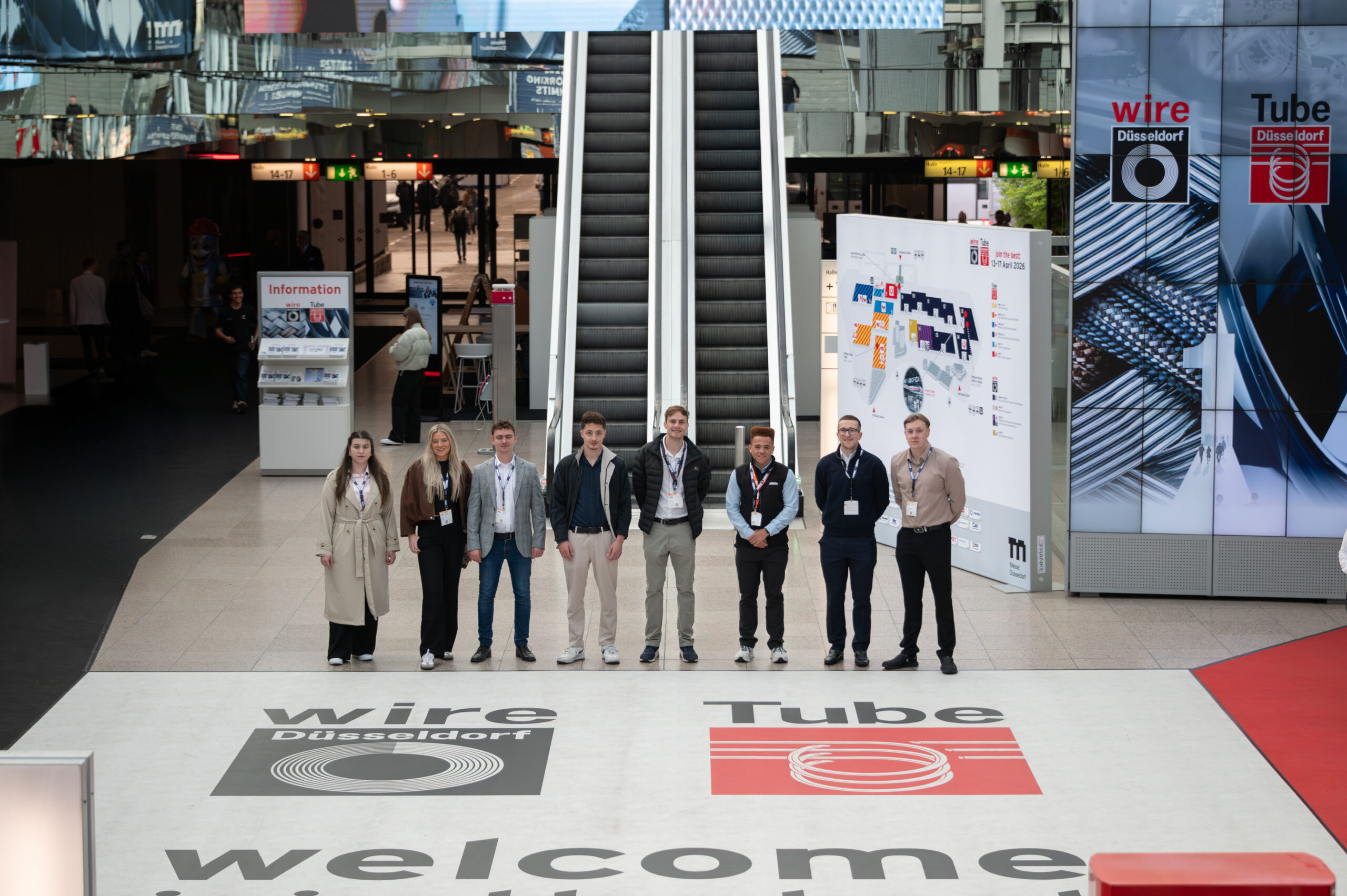
That morning, I took the train to wire Düsseldorf for the first time. After hearing others’ experiences, I arrived with high expectations: the show exceeded them. With more than 2,600 exhibitors across 16 halls, I knew I needed a plan to make the most of my four and a half days on the show floor.
On Day 1, I logged over 20,000 steps and had the resulting blisters to prove it, as I explored the halls, met new suppliers, discovered emerging technologies, and exchanged business cards at every opportunity. I thoroughly enjoyed meeting people responsible for machines I have experience with, including suppliers such as Jeff Swinchatt and John Dudus from MGS, Daniel Frankum from Zumbach, and Joaquim Abrantes from Redex.
That afternoon, Shannon Timme, director of sales for WAI, invited me to dinner in the Altstadt (Düsseldorf’s Old Town) with Mathieu St-Amour and Aaron Yaddow from Carris Reels. Over dinner, we discussed their work with Prysmian, and I was able to connect my experiences with theirs, especially when we talked about a reel-manufacturing site in McKinney, Texas, that I have visited.
On Day 2, I met Aaron Heath of Bekaert, last year’s Wire Link Scholarship recipient from the Worshipful Company of Tin Plate Workers in the U.K. He introduced me to the seven IWMA Wire Education Award Winners who were also attending. Throughout the day, I learned more about their companies through the presentations they gave and tours of their exhibitor booths. I also came across several technologies that I plan to evaluate for potential use in my processes.
Over the next few days, I spent more time exploring the exhibition halls. One of the most impressive booths was that of Niehoff Gruppe, where I met Henrik Gustafsson (senior sales) and Joachim Seitz (CEO, HFSAB). They walked me through the equipment on display, including a complete multiwire drawing machine and a running cable braiding machine. Afterward, I stepped into the sound-isolated theater within their booth to watch a video highlighting the company’s history.
On my final night in Germany, I picked up takeaway from several restaurants in the train station next to my hotel so I could sample as many local dishes as possible. With that, my experience at wire Düsseldorf was over almost as quickly as it began.
The following day, I flew to Manchester with Martin Van der Zwan, chairman of Cable Tapes UK, who served as my guide throughout the coming week in the U.K. on behalf of the Worshipful Company of Tin Plate Workers.
I spent the weekend in Manchester exploring the City Centre. As I walked through the streets, I was struck by the remarkable amount of street art and the many beautiful murals that seemed to appear everywhere. I also visited the Science and Industry Museum and the Museum of Illusions, both of which offered engaging and memorable experiences.
The city was exceptionally busy, shaped by the anticipation of a major football match between first-place Arsenal and second-place Manchester City. While walking through the streets during the game, I could hear cheers and bursts of excitement rising from buildings all around, as though the entire city had paused to follow the match. When the final whistle confirmed a victory for Manchester City, the atmosphere transformed into a celebration, with cheering, chanting, and singing filling the streets.
Over the next five days, I visited five plants representing three different companies: Bekaert, Webster & Horsfall, and Prysmian. Each site offered a distinct experience. Although many of the core processes were similar, each facility had its own unique approach to manufacturing.
Monday morning, Martin picked me up from my hotel and we drove to Bridon-Bekaert, a steel wire manufacturer in Doncaster. I spent the next two days with Aaron Heath, whom I had met the previous week.
After going through a safety presentation and suiting up in the appropriate PPE, I met Manufacturing Manager Rod Purshouse, who walked me through the shop floor. The first thing I noticed was how similar the process was to copper and aluminum, aside from the heat treatment and galvanizing steps performed before drawing.
The line begins with an oven and liquid lead bath to develop the desired properties and grain structure for drawing, followed by a charcoal filter and an acid bath for cleaning and cooling. The rod is then galvanized, filtered again to remove any excess zinc, and spooled for the drawing process.
In line with the many new things I was learning, I found it interesting that steel drawing uses a “dry” process instead of the emulsion used in nonferrous operations. The wire runs through a borax soap box before entering the die, then wraps around a capstan that is internally water-cooled to keep the wire cool ahead of the next die. I noticed that some of the wire wasn’t being drawn round.
From there, we headed to the die shop, where Dominic Tasker-Meachen walked me through how dies are refurbished and explained half-lock and full-lock wire shapes—an important detail that came up again later at the ropery.
Aaron then drove me to Newcastle to visit two Bridon Bekaert ropery sites and introduce me to Lee Fidler, the facilities operations planner. We began in receiving, where they were getting in wire that had been produced at the Doncaster plant.
I then followed it through the ropery across a range of stranding machines used to produce different finished products. I even got to watch a changeover on one machine between different size ropes. Some of them had half- and full-lock shapes that I discussed earlier, which are used to make the finished product more round as well as giving it some other unique properties.
We then drove into the port to Bekaert’s Neptune site, where the true scale of steel wire really came into focus. A dedicated stranding machine brought together already stranded ropes from six-foot reels to produce an even larger rope that could then be crane-loaded directly onto a ship.
The next day, I returned to the Doncaster facility for a tour of the Technology Center with Metallurgical Technician James Bunn. There, ropes from around the world are brought in for testing on specially built machines. These range from brand-new ropes to ropes already in service that are examined to estimate their remaining life, as well as ropes used for ongoing testing and development.
They also showed me how innovation comes to life at the facility, walking me through the creation of a one-of-a-kind product called VisionTek. It combines existing technology with some of their own to measure and analyze ropes far faster and more accurately than manual methods.
My next stop was Webster & Horsfall in Birmingham. When I arrived, Technical Manager Jack Helliwell welcomed me and first led me to the company’s history museum. There, we traced the industry-changing story that began with the Websters in 1720 and continued with the partnership with James Horsfall in 1855. I learned that they pioneered the lead-bath heat treatment method I had learned about just days earlier.
Today, the company is a leading supplier of specialty wire and wire rope. Walking through the shop floor, I saw drawing, stranding, and insulation lines that were already familiar to me yet unique for their dedicated purposes. I also saw the process for twisting and fusing rope ends together, along with the method used to install sockets on the ends of ropes.
They have a special machine to pre-stretch ropes after production, removing some of the initial stretch and saving the customer time later. They also introduced me to a process that grinds the wire surface to a precise dimension instead of drawing it down, which produces a better finish. The attention to detail and care they put into each customer-specific product were incredible and truly something to admire.
My final day of tours was with Prysmian in Bishopstoke, where they manufacture and test a wide variety of products. I was greeted by Plant Director Sergio Migliaccio, who introduced me to his team.
I then walked the injection molding floor with Luiz Dos Santos, Accessories Operations Manager, who taught me more about the process than I expected to learn, including how they improved efficiency and even built custom machines to support automation and repeatability.
I then had the pleasure of walking through the special cables plant with Engineering Manager Jose Peculo. I saw many variations of machines I had worked with before back in McKinney, along with several techniques being used in the facility that were new to me and could prove very useful in my own plants. One highlight was an in-line twisting machine on an extrusion line I had not seen before.
Jose also took me through the cable accessories facility, where they build specialized tools and equipment for a variety of cable types. Jose’s tour concluded at Joint Academy, a trade school that teaches professionals how to safely and effectively join cables in the field.
He then left me with Purchasing Manager Kate Glynn and Accessories Buyer Thomas Juszczynski, who explained how the company strategically offers a wide range of product options to meet every customer’s needs.
After their presentations, I was picked up by R&D Director Susanna Santamaria, who took me through the flame testing and high-voltage testing laboratories, where I saw machines that seemed straight out of a Nikola Tesla experiment.
With my U.K. plant tours complete, I had a day to explore London. Earlier in the week, Martin had recommended that I book a hop-on, hop-off bus tour of the city, so I did exactly that. It was hard to imagine a better way to see so much of London in a single day.
My highlights were seeing (and hearing) Big Ben, visiting Platform 9 3/4, and spotting one of the products from the Prysmian facility I had visited installed on a boat dock.
My trip had ended although there was one related visit, and that was being recognized at Wire Expo 2026. It was a fitting final touch for a trip that had exceeded every expectation I had and exposed me to more new experiences than I could have imagined.
From visiting new places and learning about different cultures to seeing a wide variety of technologies and processes across the wire and cable industry, every part of the experience taught me something valuable.
I especially enjoyed touring the different plants and seeing the different ways companies accomplished similar goals, because it gave me a broader perspective on the industry and reinforced how much there is to learn from others.
I would highly encourage anyone interested in pursuing a career in this field to apply for the scholarship, because it is an incredible opportunity to learn, grow, and build lasting connections.
I want to thank the Wire Association International and The Worshipful Company of Tin Plate Workers alias Wire Workers for partnering to make this opportunity possible. Special thanks go to Steve Fetteroll, John Drummond, Martin Van der Zwan, Aaron Heath, and all others for guiding me through the experience and making it more valuable than I could have hoped for.
Finally, I would like to thank Prysmian, Chris Tucker, and Joshua Muñoz for allowing me to take part in this truly special experience that changed my view of the industry and how much there is to learn.
Want to be a Wire Link Scholar?
It’s a long ways off, but employers might want to consider if their ranks include a good candidate for the next WAI Wire Link Scholar, who will be chosen for 2028. Candidates must have been employed in the industry for more than two years, be a WAI member, and be able to travel to the U.K./Germany for two weeks in April.
For more details, contact John Markowski, education manager, at tel. 203-453-2777 Ext. 121, [email protected].