All things in life, are subject to wear – Drawing dies are NO exception!
Written by Kurt Eder – EDER Engineering GmbH
Sooner or later and depending on the quantities of wire produced and the care with which they are used, all drawing dies wear out by abrasion, at first taking place in the reduction zone, where the incoming wire contacts the die. Later the die-bearing also wears, especially when drawing hard wire materials.
Generally speaking, the best economy and highest performance of drawing dies, with long-lasting initial dimensions, can be achieved if they are repolished as soon as an onset of a drawing ring starts, visible by the fact that the mirror-polish at the wire contact point in the drawing cone is disappearing.
With this method, the drawing die in question can remain in use for a correspondingly long time and with the original diameter before it has to be reworked to the next larger bore size and returned to further use.
If worn dies are not withdrawn for immediate refurbishment, this leads to rapid wear, resulting in the appearance of a deep drawing ring in the reduction zone, then affecting the rest of the profile and causing unacceptable out-of-size or blemished wire. In cases of heavy wear existing, these dies must be increased in size by means of suitably powered efficient machines.
Worn out dies which are not getting properly reconditioned, simply are unused treasures, leading to a situation which should not exist in any plant, aiming for the necessary high economy, as new dies have to be purchased continuously, to replace the worn-out tools.
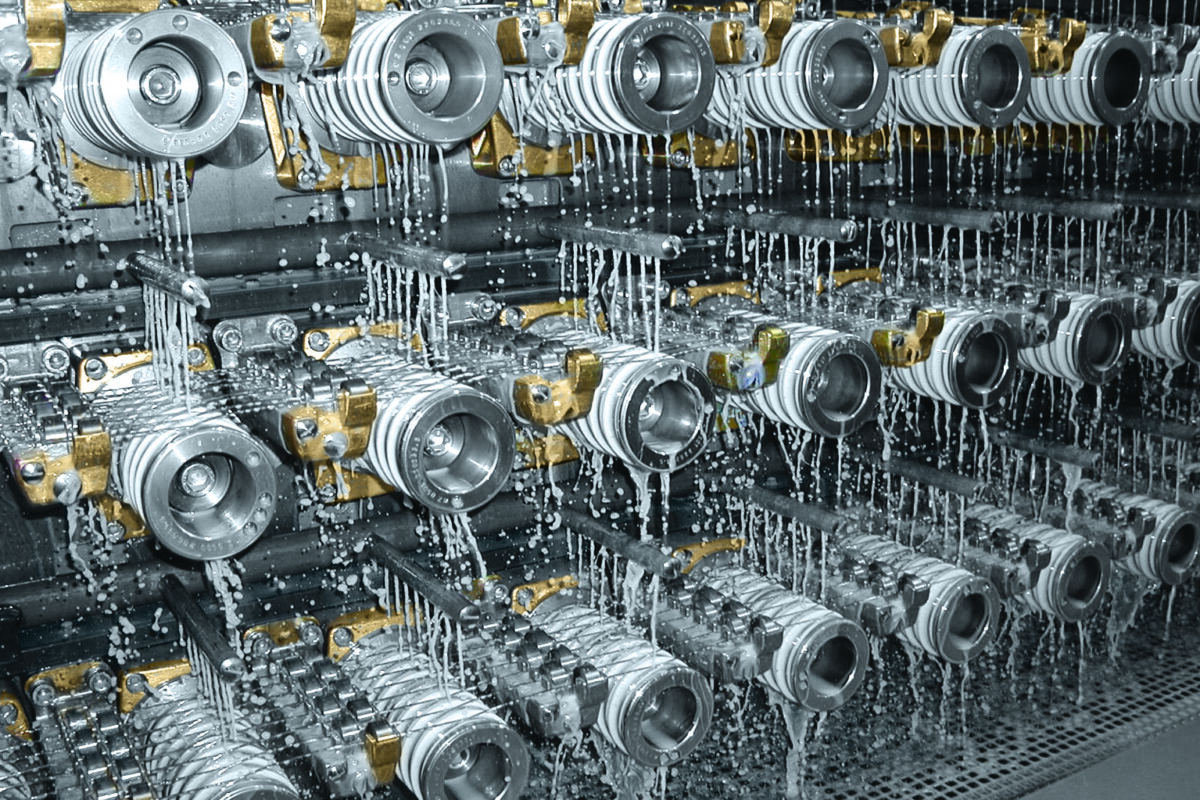
Today, the wire and cable industry, especially in the non-ferrous metal sector, increasingly uses high-performance multiple wire drawing machines, sometimes equipped with up to 48 lines. In each of these lines, sometimes 30 pcs. high-quality drawing dies made of diamond or PCD are in use, which sooner or later have to be professionally reconditioned, to maintain the required efficiency in the company.
The growing number of drawing dies that need to be repaired, often is presenting increasing problems for many companies, because frequently the traditionally available die-maintenance machines no longer offer the reworking potential that is currently required, or there is a lack of suitably trained personnel in the drawing die workshop. Often both come together.
To solve these problems, EDER Engineering-Austria, with more than 75 years of experience in this field, has developed two easy-to-use, ideally complementary high-performance machines for die maintenance, which accomplish this task with the least possible use of trained personnel and also for the entire, most important die drilling range from 0.05 up to 9 mm Ø in each case.
The first of these two machines is the powerful ultrasonic machine, type “USP TWIN”, which contrary to usual ultrasonic machines is equipped with two independently activatable powerful workstations, requires only one operator and thus offers double the throughput of repaired and reusable drawing dies.
Like all ultrasonic machines, the USP-TWIN system is ideal for grinding and polishing the conical parts of the drawing die geometry. It has two integrated needle grinding devices, oscillating polishing tables and work cycle limits, which significantly simplify all operations.
The next step is to calibrate and polish the entire quantity of drawing dies, having been already pre-machined in the cone, now also in the drawing cylinder/bearing. For this purpose and with an also identical throughput potential, the wire calibration machine, type “HGM-21″is available as the second high-performance machine needed, not to cause a “bottleneck” in the overall work operation.
Accordingly, the HGM-21 system also has two individually usable, programmable workstations and a high calibration speed required for PCD drawing dies. Once again, one operator is sufficient, and the wide working range from 0.05 to 10 mm Ø can be machined continuously.
At the end of the scheduled processing time, the respective station switches off automatically, which relieves the personnel accordingly and frees them up for other activities.
The multiple advantages of a modern die-workshop line, can prolong the service life of these important drawing tools considerably, often even maintaining their initial diameter and as such are offering:
- reduced necessary stock of die-tools and as such less cost
- accurate and flexible refurbishment at any time required
- increased competitiveness, e.g. for “just-in-time orders”
- full transparency over your diestock and refurbishment cost
- complete in-house independence
EDER Engineering GmbH, with nearly 80 years of experience, has once again set new standards for the economic refurbishment of large diamond/PCD die sets, which are now advantageously available.